Central Otago · New Zealand
The Elms Vineyard
Felton Road's original vineyard at the western end of Felton Road. Soil, slope and elevation vary markedly between blocks; named Block 2 Chardonnay and Block 3 and Block 5 Pinot Noir come from specific sectors within the site.
Grape · soil · climate
Grapes and growing conditions
What is planted
The source lists Pinot Noir, Chardonnay, and Riesling as planted here. A linked wine may use one of these grapes or a blend.
Soil and vine spacing
Recorded soil: Waenga soils on deep schist-derived fan material with loess and calcium carbonate; Lochar schist gravels with thin loess and bands of sandy clay loam. Geology: Schist parent material, ancient lake-bed sediments, alluvial fan gravels and wind-blown loess.
The description contains both coarse and finer material, so drainage and water storage may change between layers or blocks rather than behaving as one uniform soil.
Planting density: 2,667 vines/ha in the original blocks; 4,000 vines/ha in Blocks 10–13.. This describes how closely the vines are spaced.
A soil name is not a bulk-density measurement. BottlePicker only shows soil bulk density where a laboratory or modelled value exists. Texture interpretation follows USDA NRCS soil-water guidance.
Seasonal heat
Pinot Noir, Chardonnay, and Riesling: Cool-climate example; typically 1,800–2,500 growing degree days on the °F scale, equivalent to about 1,000–1,390 °C-days accumulated above a 10°C base.
Heat bands use Oregon State University Extension. The OIV climate method treats growing-season temperature as accumulated heat above 10°C, not a fixed daily target.
Site conditions
Elevation: 260–330 m.
Aspect: Predominantly north-facing valley; Block 2 slopes east and Block 6 occupies a steeper north-facing slope.
Irrigation: Applied only when monitored soil moisture requires it, generally during dry late-summer periods.
| Producer | Felton Road |
|---|---|
| Appellation / classification | Bannockburn |
| Location | Central Otago, New Zealand |
| Total area | 14.7 ha |
| Elevation | 260–330 m |
| Aspect | Predominantly north-facing valley; Block 2 slopes east and Block 6 occupies a steeper north-facing slope. |
| Soils | Waenga soils on deep schist-derived fan material with loess and calcium carbonate; Lochar schist gravels with thin loess and bands of sandy clay loam. |
| Geology | Schist parent material, ancient lake-bed sediments, alluvial fan gravels and wind-blown loess. |
| Grape varieties | Pinot Noir, Chardonnay, Riesling |
| Rootstocks | Multiple estate trial rootstocks |
| Clones / selections | Multiple Pinot Noir, Chardonnay and Riesling selections |
| Planting years / vine age | Blocks 1–9 planted 1992–1994; Blocks 10–13 planted in 2001; continuing selective replanting. |
| Planting density | 2,667 vines/ha in the original blocks; 4,000 vines/ha in Blocks 10–13. |
| Training system | VSP; cane-pruned double Guyot. |
| Irrigation | Applied only when monitored soil moisture requires it, generally during dry late-summer periods. |
| Farming | 100% organic and biodynamic; hand shoot thinning, positioning, leaf removal and bunch thinning. |
| Certifications | Demeter, BioGro Organic |
| Harvest method | Selective hand harvest with blocks, clones, rootstocks and trials kept separate. |
| Data quality | official-source |
| Record updated | 2026-07-18 |
About Felton Road
Four estate vineyards in Bannockburn, Central Otago, planted mainly to Pinot Noir, Chardonnay and Riesling on low-fertility, free-draining soils.
Estate farming: Organic and biodynamic estate viticulture since 2002; hand canopy work and selective hand picking.
Linked products in Australia
No linked bottle currently has tracked stock in this country.
4 linked products without current Australia tracked stock
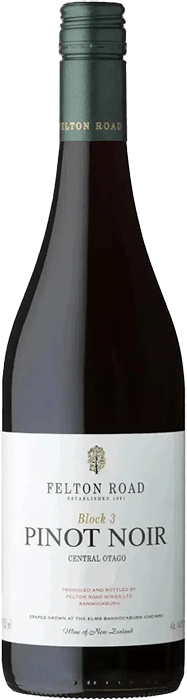 Archived
FELTON ROAD Block 3 Pinot Noir
No current tracked retailer
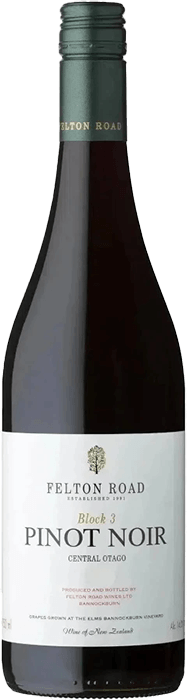 Archived
FELTON ROAD Block 3 Pinot Noir
No current tracked retailer
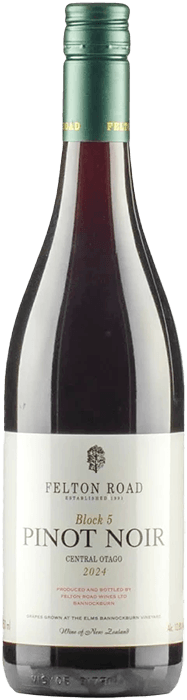 Archived
FELTON ROAD Block 5 Pinot Noir
No current tracked retailer
 Archived
Felton Road Block 2 Chardonnay, Central Otago
No current tracked retailer
Source provenance
official · accessed 2026-07-18
Fields supported: area_ha, elevation, aspect, soils, geology, grapes, planting_years, planting_density, training_system, farming, certifications, description