Central Otago · New Zealand
Cornish Point Vineyard
A 25-block site between the Clutha and Kawarau arms of Lake Dunstan. Water and steady airflow reduce frost pressure, while consistent loess-derived soils support predominantly Pinot Noir.
Grape · soil · climate
Grapes and growing conditions
What is planted
The source lists Pinot Noir and Chardonnay as planted here. A linked wine may use one of these grapes or a blend.
Soil and vine spacing
Recorded soil: Manuherikia-series moderately deep fine sandy loams: wind-blown loess over terrace gravels and older silts, with clay and calcium carbonate at depth. Geology: Post-glacial river terrace gravels and silts with loess topsoil.
The description contains both coarse and finer material, so drainage and water storage may change between layers or blocks rather than behaving as one uniform soil.
Planting density: 4,040 vines/ha; 2.2m rows and 1.13m vine spacing.. This describes how closely the vines are spaced.
A soil name is not a bulk-density measurement. BottlePicker only shows soil bulk density where a laboratory or modelled value exists. Texture interpretation follows USDA NRCS soil-water guidance.
Seasonal heat
Pinot Noir and Chardonnay: Cool-climate example; typically 1,800–2,500 growing degree days on the °F scale, equivalent to about 1,000–1,390 °C-days accumulated above a 10°C base.
Heat bands use Oregon State University Extension. The OIV climate method treats growing-season temperature as accumulated heat above 10°C, not a fixed daily target.
Site conditions
Elevation: 193–202 m.
Aspect: Low terrace almost surrounded by Lake Dunstan; rows oriented at 345° to favour morning over hotter afternoon sun.
Irrigation: Estate irrigation policy: monitored and used only when required.
| Producer | Felton Road |
|---|---|
| Local name | Cornish Point |
| Appellation / classification | Central Otago |
| Location | Central Otago, New Zealand |
| Total area | 7.6 ha |
| Elevation | 193–202 m |
| Aspect | Low terrace almost surrounded by Lake Dunstan; rows oriented at 345° to favour morning over hotter afternoon sun. |
| Soils | Manuherikia-series moderately deep fine sandy loams: wind-blown loess over terrace gravels and older silts, with clay and calcium carbonate at depth. |
| Geology | Post-glacial river terrace gravels and silts with loess topsoil. |
| Grape varieties | Pinot Noir, Chardonnay |
| Rootstocks | 101-14, Riparia Gloire, 3309, Own roots |
| Clones / selections | B114, B115, B667, B777, Abel, AM10/5, UCD 5, UCD 6, B95 Chardonnay |
| Planting years / vine age | Planted to vines in 2000. |
| Planting density | 4,040 vines/ha; 2.2m rows and 1.13m vine spacing. |
| Training system | VSP; cane-pruned double Guyot. |
| Row orientation | 345°. |
| Irrigation | Estate irrigation policy: monitored and used only when required. |
| Farming | 100% organic and biodynamic. |
| Certifications | Demeter, BioGro Organic |
| Harvest method | Hand harvested; often among the estate's earliest-picked fruit because of low elevation and lake influence. |
| Data quality | official-source |
| Record updated | 2026-07-18 |
About Felton Road
Four estate vineyards in Bannockburn, Central Otago, planted mainly to Pinot Noir, Chardonnay and Riesling on low-fertility, free-draining soils.
Estate farming: Organic and biodynamic estate viticulture since 2002; hand canopy work and selective hand picking.
Linked products in France
No linked bottle currently has tracked stock in this country.
5 linked products without current France tracked stock
 Archivé
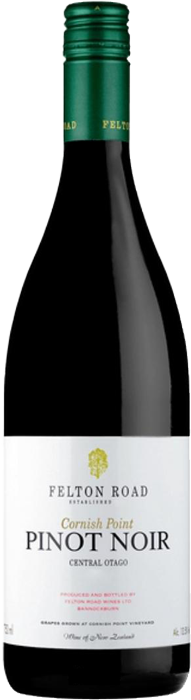
FELTON ROAD Cornish Point Pinot Noir
Aucun marchand suivi actuellement
 Archivé
Felton Road Cornish Point Pinot Noir
Aucun marchand suivi actuellement
 Archivé
Felton Road Cornish Point Pinot Noir, Central Otago
Aucun marchand suivi actuellement
 Archivé
Felton Road Cornish Point Pinot Noir, Central Otago
Aucun marchand suivi actuellement
 Archivé
Felton Road Cornish Point Pinot Noir, Central Otago
Aucun marchand suivi actuellement
Source provenance
official · accessed 2026-07-18
Fields supported: area_ha, elevation, aspect, soils, geology, grapes, rootstocks, clones, planting_years, planting_density, training_system, row_orientation, farming, certifications, harvest_method, description