Central Otago · New Zealand
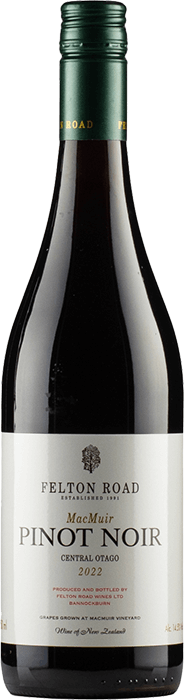
MacMuir Vineyard
A warm, low-lying Pinot Noir vineyard one kilometre east of The Elms, with unusually uniform deep silt-loam soils and high-density planting.
Daily tracked evidence
Price history for wines linked to MacMuir Vineyard
296 observations across 4 product series for wines linked to MacMuir Vineyard are retained from 25 Jul 2026 to 19 Oct 2026. None yet meets the conservative movement rule of at least three daily observations, one genuine change and a 0.5%–100% range.
Each series uses the lowest retained daily per-bottle price across tracked retailers in GBP for a product explicitly linked to this vineyard. Delivery, coupons and separately labelled live-shopping results are excluded. These are past prices. Current stock appears on each bottle page.
Grape · soil · climate
Grapes and growing conditions
What is planted
The source lists Pinot Noir as planted here. A linked wine may use one of these grapes or a blend.
Soil and vine spacing
Recorded soil: Bannockburn-series deep silt loams, with lake-bed clays, quartz sands, quartz and schist gravels, surface loess and calcium carbonate at depth. Geology: Fine tertiary lake-bed sediments with quartz and schist alluvium.
The description contains both coarse and finer material, so drainage and water storage may change between layers or blocks rather than behaving as one uniform soil.
Planting density: 4,667 vines/ha.. This describes how closely the vines are spaced.
A soil name is not a bulk-density measurement. BottlePicker only shows soil bulk density where a laboratory or modelled value exists. Texture interpretation follows USDA NRCS soil-water guidance.
Seasonal heat
Pinot Noir: Cool-climate example; typically 1,800–2,500 growing degree days on the °F scale, equivalent to about 1,000–1,390 °C-days accumulated above a 10°C base.
Heat bands use Oregon State University Extension. The OIV climate method treats growing-season temperature as accumulated heat above 10°C, not a fixed daily target.
Site conditions
Elevation: 216–224 m.
Aspect: Gentle, sheltered north-facing slope.
Irrigation: Estate irrigation policy: monitored and used only when required.
| Producer | Felton Road |
|---|---|
| Appellation / classification | Bannockburn |
| Location | Central Otago, New Zealand |
| Total area | 5.1 ha |
| Elevation | 216–224 m |
| Aspect | Gentle, sheltered north-facing slope. |
| Soils | Bannockburn-series deep silt loams, with lake-bed clays, quartz sands, quartz and schist gravels, surface loess and calcium carbonate at depth. |
| Geology | Fine tertiary lake-bed sediments with quartz and schist alluvium. |
| Grape varieties | Pinot Noir |
| Rootstocks | 3309 |
| Clones / selections | 828, 943, UCD 5, Abel, AM10/5, B114, B115, B667, B777, Massal estate selections |
| Planting years / vine age | Planting began in 2012 after soil preparation. |
| Planting density | 4,667 vines/ha. |
| Training system | VSP; cane-pruned double Guyot. |
| Irrigation | Estate irrigation policy: monitored and used only when required. |
| Farming | 100% organic and biodynamic. |
| Certifications | Demeter, BioGro Organic |
| Harvest method | Hand harvested under the estate's selective picking programme. |
| Data quality | official-source |
| Record updated | 2026-07-18 |
About Felton Road
Four estate vineyards in Bannockburn, Central Otago, planted mainly to Pinot Noir, Chardonnay and Riesling on low-fertility, free-draining soils.
Estate farming: Organic and biodynamic estate viticulture since 2002; hand canopy work and selective hand picking.
Linked products in United Kingdom
4 linked products have tracked stock in GBP.


Source provenance
official · accessed 2026-07-18
Fields supported: area_ha, elevation, aspect, soils, geology, grapes, rootstocks, clones, planting_years, planting_density, training_system, farming, certifications, description