Country-neutral wine evidence
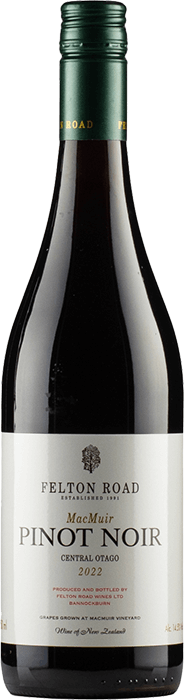
FELTON ROAD Macmuir Pinot Noir 2022 Wine (75cl)
FELTON ROAD Macmuir Pinot Noir 2022 Wine (75cl) is recorded as 2022 other wine made from Pinot Noir. BottlePicker combines the recorded bottle identity with 1 evidence-linked vineyard record; retailer prices remain separated by country and currency.
| Vintage | 2022 |
|---|---|
| Wine style | other |
| Grape | Pinot Noir |
| ABV | 14.5% |
| Bottle size | 750ml |
Prices stay local
Current price data by country
Choose a country to see prices in its own currency. BottlePicker does not mix unlike currencies into a false global lowest price.
How this wine record is connected
BottlePicker keeps identifier, origin, vineyard and availability evidence separate so one type of record is not mistaken for another.
- Bottle identity
- Structured catalogue identity
Name, producer, vintage, bottle size and origin fields are retained as the recorded catalogue identity. - Vineyard evidence
- 1 explicit link
Shown only where a wine-to-vineyard record exists; a retailer title alone never creates a site link. - Origin context
- No official context attached
Regional context appears only when the recorded origin can be matched safely.
Bottle · grape · place
What is in this wine, and where it grows
The wine
FELTON ROAD Macmuir Pinot Noir 2022 Wine (75cl) is recorded as a 2022 other wine made from Pinot Noir.
Typical grape profile: Pinot Noir — Red fruit (cherry, cranberry, red plum), earthy and floral notes, silky texture. The finished bottle can differ with vintage and winemaking.
The vineyard evidence
The evidence link identifies MacMuir Vineyard as named-vineyard with high confidence. The vineyard record lists Pinot Noir.
Soil structure and vine density
Source-recorded ground: Bannockburn-series deep silt loams, with lake-bed clays, quartz sands, quartz and schist gravels, surface loess and calcium carbonate at depth. Geology: Fine tertiary lake-bed sediments with quartz and schist alluvium.
The description contains both coarse and finer material, so drainage and water storage may change between layers or blocks rather than behaving as one uniform soil.
Vine planting density: 4,667 vines/ha.. This describes vine spacing, not soil density.
A soil name is not a bulk-density measurement. BottlePicker only shows soil bulk density where a laboratory or modelled value exists. Texture interpretation follows USDA NRCS soil-water guidance.
Growing-temperature context
Pinot Noir: Cool-climate example; typically 1,800–2,500 growing degree days on the °F scale, equivalent to about 1,000–1,390 °C-days accumulated above a 10°C base.
Heat bands use Oregon State University Extension. The OIV climate method treats growing-season temperature as accumulated heat above 10°C, not a fixed daily target.
Evidence-linked vineyard record
Source-supplied bottle description
Retained as supporting identification copy; the structured facts and evidence links above are kept separate.
A rather smoky red on the nose with earthy, shiitake mushroom, lead pencil, dark cherry and strawberry aromas and flavors. Full-bodied and layered with lots of cloves and black pepper. Only the second bottling here. From biodynamically grown grapes with Demeter certification. Screw cap.
Evidence boundary
This page combines the recorded bottle identity with linked source records. An exact region-name match supplies regional context but does not prove that this bottle carries the protected designation. A vineyard is only shown as bottle-level evidence when a wine-to-vineyard link exists. BottlePicker does not infer a vineyard, soil or site climate from a retailer title.